Fake news is more common than many people think. Some stories are fabricated so convincingly that people believe them and begin spreading misinformation. One recent source of concern is artificial intelligence. When used with harmful intent, such as propaganda, AI can manipulate images and generate stories that are not accurate.
Even the White House and politicians have been accused of altering images. According to White House correspondent Erica L. Green’s article, “They Couldn’t Break Me’: A Protestor, the White House and a Doctored Photo”, a Black woman by the name of Nekima Levy Armstrong had her face altered in a photo of her arrest. By using AI, her face was manipulated to seem as if she had been crying, even though that was not the case.
Another example of fake news is the claim that the U.S. Capitol Police gave the protestors of the Jan. 6 Capitol Riot permission to enter the Capitol. According to CWU Libraries, “A fake news website called The Gateway Pundit reported the claim on Facebook and Instagram. Even a radio show in Texas called ‘Walton & Johnson,’ ran a similar headline.” Additionally, there was evidence that the U.S. Capitol police did not permit the protestors to enter the Capitol. “U.S Capitol police officers said in an email statement to factcheck.org that the officers were blocking the whole way and attempting to de-escalate the situation by telling the crowd not to attack or assault and to remain calm.” This example further proves the damage of fake news.
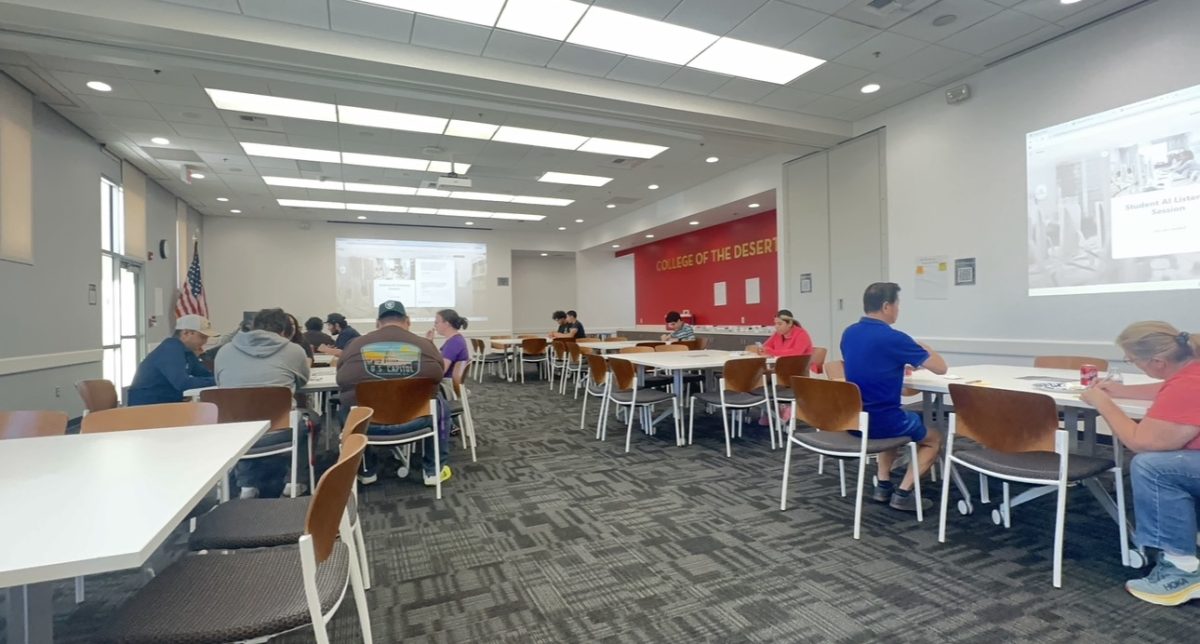
A student at College of the Desert, Guadalupe Cruz, highlighted the harms of fake news and why so many people fall victim to believing it.
“People come up with lies that couldn’t even possibly be related to the story, and it harms how the public sees the story. Fake news is harmful to society because some of us don’t really like to fact-check it. Sometimes it’s more work, or people don’t have the time for it, so they believe what’s already shown”.
Another student at College of the Desert, Kay Morgan, addresses the loophole of lies created by fake news.
“I think that fake news is extremely bad because it misleads people who can’t tell, and then they make decisions based on incorrect information. They basically lie because they were lied to.”
Fake news is harmful because it can confuse and mislead the public about important social and political issues. While it can be easy to fall for misinformation, there are ways to identify credible content. According to the International Federation of Library Associations and Institutions, there are eight key ways to spot fake news:
- Consider the source: Investigate the site’s mission and contact information.
- Read the full story: Headlines can be misleading.
- Research the author: Determine whether the author is credible.
- Check supporting sources: Verify that links support the claims.
- Check the date: Older stories may not be relevant.
- Consider whether it is satire: Some content is meant as humor.
- Examine your own biases: Personal beliefs can affect judgment.
- Ask experts: Consult a librarian or a fact-checking organization.
The next time you scroll through your social media feeds, use good judgment before believing and sharing what you see.